Blog
Blog Entries: Recent to Past

Starting the New School Year Right: Clarity Pathway Tools That Every Classroom Needs (Part 2)
Clarity’s Next Steps
In Part 1 of our July 2026 blog and newsletter, “Starting the New School Year Right”, I wrote about the clarity that must come first — knowing your Essential Standards, "unwrapping" them for teacher clarity, and then translating them into Student Learning Targets and Success Criteria that simplify the learning destination for students. This clarity is essential, but it's also just the beginning.
When your students are in front of you, the question now becomes: How do I turn this clarity into daily instruction that moves my students forward — and how do I know, in real time, whether it's working?
Here in Part 2, I’ll share with you how every PK-12 educator in every content area can answer this important question for starting the new school year right—with Learning Progressions that become the roadmap for daily instruction along with Quick Progress Checks that provide timely feedback you can use to adjust instruction as you follow that roadmap to its destination, and your students can use to adjust their learning progress along the way.
Build the Instructional Pathway: Learning Progressions
more
Starting the New School Year Right: Clarity Pathway Tools That Every Classroom Needs (Part 1)
Clarity First
There is a special kind of hope that fills an educator’s heart and mind in the days before students arrive. During my 24 years in the classroom, I always looked forward to this time of year, because it is the moment when we as educators have the greatest opportunity to set a tone that will carry our students all the way to the end of the school year and beyond.
But hope alone is not enough. As a culmination of my 50 years of combined classroom teaching and consulting experience, I have come to believe that the single most important thing a teacher can do before students arrive is not to just decorate the room, set up desks and learning resources, and decide on classroom guidelines and routines— it is to get crystal clear, first for themselves and then for their students, exactly what is essential to teach and for students to learn during this new school year, and why.
That is what the Integrated Teaching and Learning System© I created is designed to do. Here are a few of the foundational “timeless essentials” from the ITLS framework that can help you start this year with this essential clarity.
Know Your Destination: Essential Standards
more
The Clarity Pathway Tools for Educators to Finish the Year Strong!
The System Does the Work
As the end of the school year approaches, I hope you will reflect on and celebrate all the good you have accomplished professionally this year! We all know that complete success doesn’t happen overnight, or in one school year only. I want to share with you two profound success stories of student learning gains, achieved over time, that truly are worth celebrating!
A Virginia school district leader was happy to share with me the dramatic gains accomplished by the collective efforts of all her school administrators, educators, students, coordinators, and instructional support staff:
"Over the past several years, Danville Public Schools has made significant progress by strengthening instructional leadership, aligning curriculum with Larry Ainsworth’s Integrated Teaching and Learning System, and using data to drive continuous improvement. As a result, the number of fully accredited schools in the district doubled—the largest increase in more than a decade—and the district’s state accountability rating rose with eight of our ten schools scoring between 80–100 points, and one earning Distinguished status.
“Our progress has also been recognized regionally, with six schools earning Virginia Department of Education Region VI Leaderboard Top 5 recognition across eight key performance areas, including reading and math growth, English learner progress, graduation rates, and college and career readiness. These results reflect the power of sustained focus, strong leadership, and a districtwide commitment to improving outcomes for every student."
more
Composing Big Ideas and Creating Essential Questions
Note: Big Ideas and Essential Questions are great tools and best utilized as part of an Integrated Teaching & Learning System. See additional resources at the bottom of this blog.
Big Ideas are the three or four foundational understandings—main ideas, conclusions, or generalizations derived from the unit's "unwrapped" concepts—that you want your students to discover and state in their own words by the end of a unit of study.
Notice something critically important in that definition: your students discover them. You don’t just tell them. You determine the Big Ideas in advance as part of your "backwards planning" so that you know where the learning journey is headed. Then, through intentional daily instruction and carefully designed learning activities, you guide your students to arrive at those understandings on their own.
Big Ideas are the "lightbulb moments"—when a student suddenly says, "Oh! I get it now!" and goes on to articulate the meaning he or she has just come to understand. That is learning that sticks. That is understanding that transfers.
Marion Brady, writing in the Phi Delta Kappan, captured the neurological truth behind this: "People need 'large-scale mental organizers' or 'big ideas' to help them organize and make sense of the myriad facts they must learn." Facts without Big Ideas are soon forgotten. Big Ideas give facts a place to live.
more
Practical Application Questions About Success Criteria
In my January 2026 blog, I describe the importance and techniques for aligning Success Criteria to Student Learning Target(s). In this blog I would like to share answers to practical application questions about Success Criteria based on my 25 years of providing professional learning workshops on “timeless” essential practices to school and district leaders and PK-12 educators. For a refresher on what Success Criteria are and some related fundamentals, check out my January blog: https://www.larryainsworth-claritypathway.com/blog/successcriteria
Q: “Aren’t Success Criteria the same as rubrics?”
Success Criteria are not the same as rubrics. Success Criteria are a single set of objectively worded verb phrases that clearly list what students need to do to “hit the bullseye” of the Student Learning Target(s). Rubrics, even though worded with verb phrases like Success Criteria, include different levels of proficiency, with each level listing the verb phrases specific to that level only. Rubrics, also known as scoring guides, are multi-level Success Criteria—but only if they are correctly written with objectively worded—not subjectively worded—verb phrases.
more
Aligning Success Criteria To Student Learning Targets
Together with Student Learning Targets that communicate to students what they are to learn and why it is important for them to do so, Success Criteria show students how they will need to demonstrate that they have learned it. Educators closely study both their “unwrapped” Essential Standards and the related Student Learning Targets from which they are derived to determine the matching Success Criteria. The benefit of doing so? Success Criteria make clear for learners exactly what they need to write, say, and/or do to provide valid evidence that they have successfully “hit the bullseye” of the Student Learning Targets.
I especially like the visual imagery Michael Absolum uses to introduce both a Student Learning Target (which he calls “learning intention”) and Success Criteria to his students:
“I introduced the term learning intention to my students and explained that this was going to be the flashlight in my teaching and their learning. We talked about our learning being like a journey through a tunnel. This was where I introduced success criteria, and we likened them to signposts along the way through the tunnel. Often a picture of the flashlight was placed beside the words learning intention and signposts beside the success criteria." (Absolum, Clarity in the Classroom, 2010, p. 83)
more
Co-creating Student Learning Targets With A.I.—THOUGHTFULLY!
Just as “unwrapping” Essential Standards provides educators with the “gift of clarity” to fully understand the Essential Standards that they will teach to their students, the way to communicate that same clarity to students is to “translate” those standards into Student Learning Targets and then to explain their purpose when first introducing them to the students.
As the invited guest on a recent education podcast show, I was asked by the host what I thought about educators being able to ask A.I. to create learning targets and success criteria for them because it’s so quick and easy to do. I replied that using A.I. as a time-saving tool is fine to do, IF educators already understand their purpose, and especially if they know how to use them effectively with their students every day.
In this blog post and the related issue of our Integrating Teaching and Learning Newsletter, I clarify how A.I. can be thoughtfully used to expedite the creation of Student Learning Targets after educators first understand the “what, why, and how” of this all-important component of instruction. Otherwise, they may just be using A.I. as an isolated shortcut for creating this key element without understanding its potential impact on student learning when used correctly.
more
Transform the Way You Design Learning
“Timeless Essentials” Together in ONE Integrated System!Transform The Way You Design Learning with Larry Ainsworth's Integrated Teaching and Learning System© -- A Step-by-Step Blueprint for Educational Excellence
I always think it’s essential when introducing any new professional learning practice to busy educators and leaders to first clarify the “why” of the topic in focus, not just the “what” and the “how”. Without a compelling or convincing “why”, the “what” and “how” are usually looked upon as “just one more thing to do” on top of everything else they are already doing.
Here’s the “why” behind my Integrated Teaching and Learning System© (ITLS)—a powerful, step-by-step process I created that unites curriculum, instruction, and assessment into one coherent design to ensure that every standard, lesson, and assessment is aligned and purposeful. Think of this system as a blueprint for building or remodeling your classroom, school, or district curriculum—with each stage purposefully connected to the next. This systematic approach helps educators ensure that all students acquire the skills and knowledge they need to succeed. When teaching and learning are fully integrated, students gain not just knowledge—but lasting understanding.
more
Essential Standards for Multilingual Learners
This blog answers many of the frequently asked questions (FAQs) about Essential Standards I ha. Recent questions are about how Essential Standards can assist multilingual learners, and in this blog post, I respond to one of those FAQs that goes to the heart of the matter.
Question: “Isn’t focusing solely on Essential Standards for multilingual learners providing them with a ‘watered-down’ education? How do you respond to that concern?”
There is a fundamental misunderstanding here about what Essential Standards are and what their actual purpose is. “Watered down” implies lowered learning expectations, simplified content, less rigorous work, and settling for minimum competency. When multilingual students struggle with language, educators often consciously or unconsciously lower their expectations for those students, eliminating from their instruction the more challenging content. Essential Standards represent the highest cognitive demand and those important concepts and skills that ALL students need to know and be able to do. Essential Standards are the opposite of “watered down”; they are the distilled essence of what matters most for student learning—in school and for future success in life.
more
Essential Standards for Students With Disabilities
Having guided leaders and educators through the six-step Essential Standards selection and alignment process across PK-12 grades for the past 25 years, I continue to receive and respond to frequently asked questions (FAQs) about Essential Standards through my workshops, podcasts, and in my published books. Several of these questions relate to students with disabilities and require in-depth responses. For this blog post, here are a few examples of FAQs with my detailed responses about how Essential Standards specifically apply to students with disabilities.
Essential Standards and IEPs
Question: “You mention that special education teachers can use Essential Standards when writing IEPs—Individualized Education Plans—and that since these teachers often serve students across multiple grade levels, Essential Standards help them quickly identify what matters most for each student. Will you provide us with a concrete example of how this works?
Here are several concrete examples, first in math and then in reading, to show how educators of students with learning disabilities can use Essential Standards to write student-specific IEPs.
more
ALIGN ESSENTIAL STANDARDS ACROSS THE GRADES, PK-12
After the Essential Standards are identified for the separate grade levels, as discussed in my previous blog post, they must then be aligned across the grades, PK-12, to determine the instructional progression of those priorities from one grade level to the next by referring to the grade levels above and below each one. And this alignment must be seamlessly apparent from pre-kindergarten through high school to ensure that the organization of learning progressions, carefully built into the design of the state standards, remains intact.
Reprinted here from my Part 2 blog are the six Essential Standards process steps. The third step describes in detail the PK-12 alignment process, and the related fourth step serves as a “cross-check” to ensure that the aligned Essential Standards include the standards emphasized the most on state assessments.
Step 1: Make initial selections using the four selection criteria. Reach initial consensus.
Step 2: Bold selections for each grade or course on Google sheets or Excel spreadsheets.
Step 3: Align Essential Standards PK-12. Resolve uncertainties. Reach group consensus.
more
Prioritization, Not Elimination! Preview the complete six-step process:
Part 2 of this blog series strongly points out the importance of “prioritizing, not eliminating” any standards, describes how educators are using the long-established criteria for identifying Essential Standards, and previews the complete six-step process.
Prioritizing certain standards over others does not mean eliminating those standards that do not “make the cut” into the Essential Standards category. Prioritizing the standards has nothing whatsoever to do with “lowering the bar,” and everything to do with focus. It is about “less being more”. The difference lies in the degree of focus given to certain standards over others.
Identifying Essential Standards is not an irresponsible recommendation to ignore any standards not designated as priorities. It is imperative to continually remind everyone in the school and district community, “The Essential Standards are not all we teach,” even while allocating the greatest amount of instruction and assessment time to those standards determined to be essential for student success in current and succeeding grade levels. I always advise educators and school leaders to continually communicate to everyone this message: “Prioritization, not elimination!”
more
"TOO MANY STANDARDS, TOO LITTLE TIME!” A PRACTICAL SOLUTION TO THE EDUCATOR’S DILEMMA -- ESSENTIAL STANDARDS!
Educators throughout the U.S. continue to face the daunting challenges—constraints—associated with the teaching and assessing of students’ understanding of all state standards. Among those challenges are several vitally important ones: (1) student unpreparedness for current grade-level standards as well as next grade-level standards; (2) teaching students how to achieve the different levels of rigor in the standards; (3) the influx of new educators unfamiliar with the standards; (4) the mobility of students that interrupts their learning; (5) the need to review existing standards that were selected as priorities years before but have not been reviewed and updated since; (6) the need to reprioritize new and/or revised state standards; (7) lack of coordinated efforts within a school system to engage all teachers in the selection and alignment of prioritized standards across the grades.
How can classroom teachers be expected to teach, assess, re-teach, and reassess students on every standard in a grade level or course within the limited number of school days each year, especially when there can be as many as 70, 80, and even 90 or more standards in any given content area at nearly every grade level? Realistically, they can’t—unless they default to the “inch-deep, mile-wide” superficial coverage approach to standards whereby they quickly teach a standard and then move on to the next standard whether the students are ready to do so or not.
more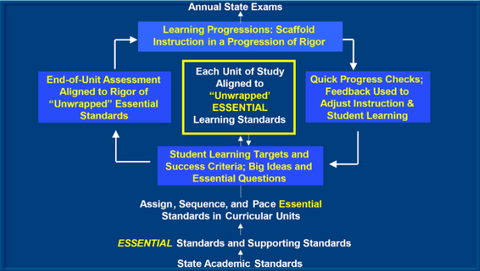
Can “Timeless Essentials” Help Prepare Students for Success on State Assessments?
As the graphic illustrates, when all the “timeless essentials” work together to create an integrated system of curricular units, they can help prepare students for success on the annual state exams! By aligning all these elements, one to another, in a deliberate design sequence, educators gain ongoing evidence of student learning that can serve as predictive value for how students are likely to perform on state tests.
Beginning at the bottom of the chart and following the arrows to the top, Essential Standards and supporting standards (those not identified as “essential”) are assigned to each unit of study. Within each unit, educators will “unwrap” the Essential Standards, create related Student Learning Targets, Success Criteria, Essential Questions with corresponding Big Ideas.
Next in the unit design sequence, educators create/select the end-of-unit assessment directly aligned to the Essential Standards, before planning unit instruction, so they know in advance what students will need to learn and be able to do on that culminating unit assessment. They can then intentionally plan their daily instruction with Learning Progressions that scaffold the rigor of fundamental concepts and skills in supporting standards to the rigorous concepts and skills represented in the Essential Standards. Students respond to daily Quick Progress Checks—aligned to the rigor of the end-of-unit assessment questions—so that educators can adjust their follow-up instruction based on student feedback and students can use educator feedback to adjust their learning strategies—all to prepare students for success on the end-of-unit assessment.
more
ALIGN SUCCESS CRITERIA TO STUDENT LEARNING TARGETS!
Integrating Teaching & Learning: “Timeless Essentials” for Creating Integrated Units of Study
During my 24 years of classroom teaching, I often co-created rubrics with my students so they would know exactly how to succeed on classroom projects and performance tasks. But when I learned about Success Criteria years later, I could only wish that I had known about this powerful practice “back in the day!”
In Volume One, Chapter 6, of my new book series, Integrating Teaching and Learning: “Timeless Essentials” for Creating Integrated Units of Study, I share in detail how to align Success Criteria to Student Learning Targets. Today’s blog post introduces this powerful education practice that all educators in all grades and content areas can easily implement in their own classrooms and instructional programs.
WHAT ARE SUCCESS CRITERIA?
Together with Student Learning Targets that communicate to students WHAT they are to learn, Success Criteria provide explicit verb phrases to show students HOW they will demonstrate that they have learned it. Success Criteria make clear for learners in specific, objective wording exactly what they need to write, say, and/or do as valid evidence that they have successfully “hit” the Student Learning Target(s). Think of Success Criteria as a detailed “roadmap” to the identified learning destination. Each criterion is a “checkpoint” on the journey. When students complete all the “checkpoints”, they have arrived!
more
Linking A.I. to “Timeless Essentials”
From my many years of experience in leading educators and leaders through the curriculum-design process, “timeless essentials” are what I have come to refer to as the necessary components that make up quality units of study.
Where’s The Time?
Educators today are more pressed for time than ever before. Educators and leaders certainly understand the value, benefit, and importance of creating or updating their curricular units of study to improve instruction and student learning. But with so many professional tasks, concerns, and responsibilities to deal with every single day, they will understandably think or say, “I’d love to be able to do this myself or with colleagues, but where’s the time to do so? I’m already feeling stretched to the limit.”
How to Make Unit-Design Doable?
Being mindful of these real challenges, I considered how to make the unit-design process as doable as possible. I began researching Artificial Intelligence platforms and apps to see if A.I. tools could help busy educators expedite the creation of each of these essential elements. After several experimental tries, followed by my careful evaluation of the A.I.-generated responses, I realized that they most certainly can.
more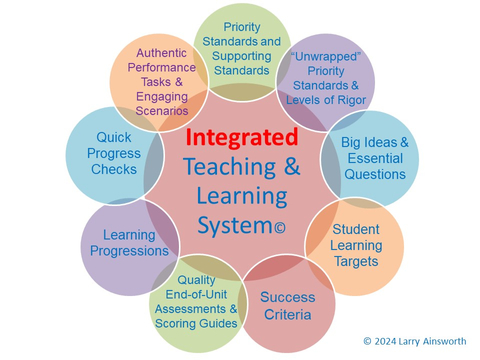
Problem: Student Clarity, Solution: Learning Targets!
Integrating Teaching and Learning: Creating Integrated Units of Study
WHAT: Student Learning Targets are simpler statements that communicate to students the complex learning expectations of the standards in age-appropriate language they can understand.
Student Learning Targets are “timeless essentials”, foundational to quality units of study. They specifically derived from the “unwrapped” Essential Standards assigned to each unit or set of related lessons. Think of each Student Learning Target as a simply reworded, essence statement without the explicit details and complex wording included in the standard.
Like the “unwrapped” Essential Standards, Student Learning Targets serve as the focal points of instruction, learning activities, and assessments. Their value lies in helping students make clear connections between what they are learning and how they can set a personal learning goal to achieve that learning.One aspect of creating integrated units of study that educators often find most valuable is after prioritizing and "unwrapping" standards (steps explained in the book link below), the next step is to make sure that students are clear about what their teachers want them to learn. Just as “unwrapping” provides educators with the clarity they need to fully understand the Essential Standards they are about to teach to their students, the way to communicate that same clarity to students is to “translate” those standards into age-appropriate student wording.
more
“unwrapping” the Standards - a Simple Process to Clarify Student Learning Outcomes –20th Anniversary Reprint!
November 21, 2023 9amLarry Ainsworth
Amazon Link to book: https://tinyurl.com/354perdj
It’s TIMELESS! 20 years later and still going strong!
In this 20th anniversary reprint of the 2003 original edition, with a new subtitle, “Unwrapping” the Standards, A Simple Process to Clarify Student Learning Outcomes, Larry Ainsworth guides educators through each phase of the “unwrapping” standards process. Sharing the stories of K-12 educators and leaders across the country who have successfully implemented this process, Larry convincingly explains why “unwrapping” standards continues to be a “timeless” practice to elevate teaching and learning.
“Unwrapping” the standards is a simple but powerful practice to help educators clarify what students need to know and be able to do from the wording of the standards. When educators take the time to analyze each standard and identify its essential concepts and skills, the result is more effective instructional planning, higher quality assessment design, and improved student learning.
Overview of the “Unwrapping” Process
more
Power Standards: Identifying Standards Essential for Student Success – 20th Anniversary Reprint!
November 9, 2023 1pmLarry Ainsworth
Newly Republished on Amazon KDP: October 18, 2023
Amazon Link to Book: https://tinyurl.com/5n6esr9e
An ENDURING practice! 20 years after the original edition and still going strong! In this 20th anniversary reprint of the initial 2003 publication, Power Standards: Identifying the Standards Essential for Student Success is a practical, “how-to” manual that explains step-by-step how teams of educators can collaboratively identify and vertically align, K-12, the Power Standards.
Power Standards, known also as Priority Standards, are a prioritized subset of state standards within each grade level and content area that educators use as a foundation for developing high-quality curriculum and assessments. Other standards, not identified as priorities, are not eliminated. They serve as supporting standards to assist students in learning the more rigorous Power Standards.
Why Power Standards? All standards are not equal in importance. Many standards require more time and focus than other standards to prepare students for current and future success—in school, in life, and on high-stakes assessments. In-depth instruction of essential concepts and skills is more effective than “covering” all standards superficially. Owing to the limitations of time and the wide diversity in learning backgrounds of today’s students, educators are faced with the almost insurmountable task of trying to teach all the standards and all the indicators for their individual grade and content areas while at the same time meeting the extraordinary range of student learning needs. Prioritizing standards provides the only logical solution for addressing this challenge!
more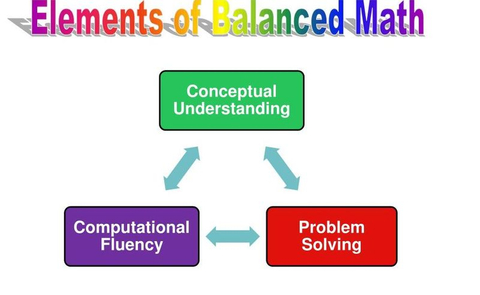
Five Easy Steps to a Balanced Math Program
Date of Blog Post: April 12, 2022
Newly Republished on Amazon KDP! A Simple Framework That Works with Any Math Textbook Series to Create Mathematically Powerful Students!
FIVE EASY STEPS TO A BALANCED MATH PROGRAM by Larry Ainsworth & Jan Christinson
3 Separate Grade-Band Editions and the Amazon Links to the Books:
- Primary Grades (K-2) https://tinyurl.com/bdz7jrz5
- Upper Elementary Grades (3-5) https://tinyurl.com/5n7x7vt3
- Secondary Grades (6-12) https://tinyurl.com/39udyu7b
“Five Easy Steps to a Balanced Math Program has revolutionized the way our teachers approach math instruction! The five steps not only represent best practice; they are easy to understand and can be implemented by our teachers immediately following awareness/training sessions. The philosophy of the five steps reinforces our desire to create mathematically powerful students. Five Easy Steps to a Balanced Math Program is so highly regarded in our school district, it has made our list of “non-negotiable” professional practices!”
more
Common Formative Assessments 2.0
Date of Blog Post: March 29, 2022
Newly Republished on Amazon KDP! Common Formative Assessments 2.0: How to Write Quality Assessment Questions Aligned to the Rigor of the Standards for In-Depth Instruction and Assessment (Ainsworth, 2021)
ENDORSEMENT BY JOHN HATTIE:
“Ainsworth spells out how classroom teachers can work together to create formative assessments in order to monitor student learning and adapt teaching. The new material in this book is critical: Ainsworth introduces constructive alignment of learning outcomes, standards, success criteria, and classroom and larger-scale assessments. He emphasizes the quality of assessments to enable excellent diagnostic interpretations of data. He does not ask teachers to do all this alone, but as a community of experts led by instructional leaders (the chapter on PLCs in itself is worth buying the book). He does all of this with the intention of maximizing our positive impact on student learning. There have been many who have written about the power of success criteria, growth and progress, and assessment for teachers, but not how to do it.
more
Big Ideas & Essential Questions
How to Write Big Ideas & Essential Questions from “Unwrapped” Priority Standards
Date of Blog Post: March 15, 2022
Newly Republished on Amazon KDP! “Unwrapping” Common Core State Standards: Deconstructing Priority Standards to Identify Levels of Rigor, Big Ideas, and Essential Questions (Ainsworth, 2022)
Amazon Link to Book: https://tinyurl.com/yzs9mxwb
IMPORTANT NOTE TO READERS:
My newly republished book specifically addresses how to “unwrap” the Common Core State Standards in both English language arts and mathematics. The process educators use to “unwrap” their own state standards and write Big Ideas and Essential Questions in any grade, course, and content area, is directly relevant and applicable to ALL state standards—not to the Common Core only.
In addition to first seeing how to “unwrap” Priority Standards and identify related levels of thinking-skill rigor, you will learn how to:
- Determine Big Ideas (the aha’s or “lightbulb” moments of understanding) you want your students to discover as they learn the “unwrapped” standards.
- Write Essential Questions that engage students and lead them to their own discovery of the Big Ideas.
- BONUS: See 60 examples of “unwrapped” English language arts and math standards with Big Ideas and Essential Questions specific to K-2, 3-5, 6-8, and 9-12 grade bands!

How to “Unwrap” Priority Standards
Date of Blog Post: March 9, 2022
Newly Republished on Amazon KDP! “Unwrapping” Common Core State Standards: Deconstructing Priority Standards to Identify Levels of Rigor, Big Ideas, and Essential Questions (Ainsworth, 2022)
Amazon Link to Book: https://tinyurl.com/yzs9mxwb
IMPORTANT NOTE TO READERS:
My newly republished book specifically addresses how to “unwrap” the Common Core State Standards in both English language arts and mathematics. However, why the “unwrapping” of standards is a powerful method for clearly understanding the standards, and how educators can “unwrap” their own state standards in any grade, course, and content area, are directly relevant and applicable to ALL state standards—not to the Common Core only.
Through explanations and examples, you’ll learn how to:
- Clarify specific concepts and skills that students need to know and be able to do from the wording of the Priority Standards;
- Identify the levels of thinking-skill rigor in the Priority Standards in order to directly match assessment questions to those levels of rigor;
- Determine Big Ideas (the aha’s or “lightbulb” moments of understanding) you want your students to discover as they learn the “unwrapped” standards; and
- Write Essential Questions that engage students and lead them to their own discovery of the Big Ideas.
- BONUS: See 60 examples of “unwrapped” English language arts and math standards with Big Ideas and Essential Questions specific to K-2, 3-5, 6-8, and 9-12 grade bands!
Prioritizing Common Core State Standards: Identifying Rigorous Standards for in-depth Instruction and Assessment
Newly Republished on Amazon KDP: February 24, 2022
Amazon Link to Book: shorturl.at/qxAS3
Important Note to Readers:
The content of this republished book specifically addresses how to prioritize the Common Core State Standards in both English language arts and mathematics. However, the rationale for why the prioritizing of standards is necessary, and how educators can prioritize and vertically align their own state standards, K-12, in any content area, are directly relevant and applicable to all state standards–not to the Common Core only.
Several important benefits readers will gain from the book’s final chapters are the narratives by district leaders from six different school districts in six different states. Contributed specifically for this publication, these first-person accounts describe in detail how these leaders successfully carried out the project of prioritizing the CCSS — by fully involving their classroom educators at the center of this important decision-making process.
The power of prioritizing standards, proven by educators and leaders in school systems across North America over the last 22 years, lies in the doing, in the experience of the process. Here’s an overview of the rationale and process for prioritizing your own state standards:
more
“I Touch the Future; I Teach”: Teaching as Selfless Service
CONNECTING INSPIRATION TO “TIMELESS” EDUCATIONAL PRACTICES
It’s been my joy and privilege to serve education for nearly 20 years as an author and consultant of effective practices to use with standards, assessment, curriculum, and instruction. I love seeing PK-12 educators and leaders across the country experience “lightbulb moments” while going through the Common Formative Assessments 2.0 and Teacher Clarity workshops I created for Corwin.
As important as these “timeless practices” continue to be, I’m now bringing a new—and vitally important—connection to my ongoing work with educators: inspiration.
The word “inspiration” comes to us from the Latin verb, inspirare, meaning “to breathe into”. In Middle English, it signified, “divine guidance.”
Inspired teachers—those who know why they teach and are motivated by that passionate purpose to help their students succeed—can effectively impact student learning even more than they may realize. How?—by infusing heart-felt inspiration into their teaching practices. When teachers apply research-based practices in an inspired way, they are interweaving heart and mind. A powerful combination that cannot help but improve student learning dramatically!
more
The Clarity Problem—and the Teacher Solution!
What IS Teacher Clarity?
Simply put, teacher clarity means an educator has absolute clarity about what students are to learn, know, and be able to do for an upcoming instructional focus before they plan any instruction and assessments.
The Clarity Problem
Today there’s a lot of fuzziness around learning outcomes. Teachers aren’t crystal clear about what they’re supposed to be teaching. Students often confuse what they’re learning with what they’re doing. They can tell you about the activities they’re engaged in, but not the intended learning those activities are designed to achieve.
The Clarity Solution
When teachers are certain about their learning intentions—what they want students to know and be able to do in a unit of study and in specific daily lessons—they can intentionally design assessments, plan instruction, and select appropriate curriculum materials directly aligned to those learning intentions. Teachers write the learning intentions in student-friendly language so students will be clear about what they are expected to learn.
Success criteria—specific descriptors of how students will achieve the learning intentions—provide teachers and students with a detailed “roadmap to the destination” that focuses instruction and motivates students to engage in the learning.
more
Where is Formative Assessment Flourishing? In Valley View School District
Today an educator may equate the word, “assessment” to “test,” and as such, see it as an isolated event that takes place periodically: at the end of the week in the form of a quiz, at the end of a unit of study as a culminating measure of achievement, at the end of a marking period to help determine an overall student grade—or annually as the high-anxiety-producing standardized achievement test.
But “assessment” is not just another word for “test” or “exam”, two terms which indicate a summative evaluation. Formative assessment evaluates a student’s current understanding or ability before, during, and after instruction. Yet that’s only part of it. The assessor and the assessed then need to do something with the results if any real benefit to student learning is to be gained.
Formative Assessment’s Chief Purpose—To Inform and Adjust Instruction and Learning
Formative assessment’s chief purpose and function for teachers is to inform instructional decisions and to make instructional adjustments accordingly. Formative assessment’s true purpose and function for students should be to show them where they need to adjust their learning strategies in order to achieve the stated learning targets.
more
Formative Assessment Can Flourish if…
On June 30, 2017, I co-presented a breakout session entitled, “Formative Assessment: Flourishing or Floundering?” with two of my education heroes, W. James Popham and Margaret Heritage, at NCSA, the National Conference on Student Assessment, in Austin, Texas. This post summarizes my stance on this important topic:
Formative Assessment: Is it still flourishing as it was in recent years?
My position is yes, it still is, but only if and when certain key factors are in place. And the first factor is the clear understanding of formative assessment’s chief purpose and function.
In 2011, I heard W. James Popham, foremost expert on assessment, define formative assessment and its true purpose as follows:
Because we are talking here about formative assessment, that adjective clearly indicates that the assessment is taking place while students are in the process of learning. Formative assessment evaluates a student’s current understanding or ability before, during, and after instruction. But that’s only part of it. The assessor and the assessed then need to do something with the results. If they don’t, this but adds further grist to the mill of popular opinion that as a nation, we are “over-testing and under-assessing” our students.
moreTimeless Practices to Improve Student Learning
What are those educational practices that can rightly be called, “timeless”?
In my long career as an education author and consultant (21 years and counting!), I’ve had the privilege of teaching educators and leaders across North America key methods I’ve developed for prioritizing and “unwrapping” standards, writing formative assessments and scoring guides, and designing rigorous curricular units of study for every grade level and content area. However, it wasn’t until the last couple of years that I realized the timelessness of these practices.
Educators know that their state or provincial standards are what they must teach their students. They also know that they must regularly assess their students’ understanding of those standards, and then use the assessment results to inform and adjust their teaching—selecting appropriate instructional strategies and relevant curricular materials to do so. This is the main work and responsibility of each and every teacher, from preschool through high school. And this core responsibility will not change, no matter what external changes continually impose themselves on the day-to-day life of every teacher, particularly within the United States.
more
Priority Standards: the Power of Focus
Larry Ainsworth, author of Prioritizing the Common Core: Identifying Specific Standards to Emphasize the Most (2013)
So many standards, so little time…
How can classroom teachers be expected to teach, assess, re-teach, and reassess student understanding of each and every standard in a grade level or course within a limited number of school days each year—especially when there can be as many as 70, 80, and even 90 or more standards in any given content area?
Realistically, they can’t—unless they practice the “inch deep, mile wide” coverage approach to standards whereby they teach it, the students likely don’t get it, but it’s time to move on because they have to cover every standard before the annual state test. Anyone who has ever taught students for any length of time knows this doesn’t work, and yet the practice continues.
Why?
Because the expectation persists that all standards are of equal importance and teachers must ensure their students learn all of them each year—regardless of the extraordinary range of students’ language levels and learning needs that only add to the instructional challenge teachers face.
In response to the immense testing pressures educators are under today, this “spray and pray” method of instruction may seem the only viable solution. But it inevitably results in students leaving one grade or course unprepared for the next. Teachers at the next level must then re-teach what students “should have learned” in the prior grade or course before they are able to begin teaching their own standards. This situation repeats itself year after year, ultimately snowballing to produce older students who are often several years behind in their learning.
more
“Unwrapping” the Standards: a Simple Way to Deconstruct Learning Outcomes
Contributed by Larry Ainsworth, author of “Unwrapping” the Common Core: A Practical Process to Manage Rigorous Standards (2014)
This post was originally published on Finding Common Ground.
To “unwrap” or not to “unwrap”? – Actually, there is no question.
In addition to the voluminous numbers of standards teachers must impart to their students each year, there is the added challenge of really understanding what the standards means. It’s one thing to read a standard and get a general sense of what it’s about. It’s another thing to thoroughly understand what it explicitly and implicitly indicates. What is it that students must know and be able to do as stated in each of these learning outcomes?
“Unwrapping” is a simple method that all teachers in all grade levels can use to deconstruct the wording of any standard in order to know its meaning inside and out.
Why is this important? If teachers aren’t crystal clear about the full and precise intent of a given standard, how can they accurately teach it? How can they accurately assess student understanding of it? How can they clearly communicate to students the specific learning intentions for a unit of study? Answer: Without first analyzing the standard, they can’t.
more
Larry Ainsworth: Ffrom then to now and beyond
THE BEGINNING
A native Californian, 22 years old, straight out of college with a minor in education, I wanted to teach! The year was 1970 and Chicago Public Schools was in need of teachers, so that’s where my orange VW bug took me. Having no student-teaching experience, and without any teaching credential, I was issued an emergency certificate on condition that I immediately enroll in teaching methods courses at Chicago State University. I was about to become a real teacher!
The inner-city K-8 school to which I was assigned was a three-story brick building built in the mid-to-late 1800s. An overcrowded neighborhood school with too few classrooms to house its 1000 students, the only viable solution was to split the school day for students in grades 4-8 into two four-hour shifts (K-3 attended the full day). So from 8:00 a.m. to 12:00 p.m., one teacher and students occupied the classroom but had to quickly exit at noon to enable the 12:00 to 4:00 p.m. teacher and students to use it for their four hours. Two teachers and their students sharing the same space, furniture, books, materials, and bulletin boards—orderly chaos on a daily basis! But this taught me one of the most critical skills every teacher needs to learn—flexibility! And I developed that skill while figuring out how to teach students who were well below their current grade level and desperately in need of more than four hours of education each day.
more
2015 Corwin author consulting retreat: from ideas to impact
When professional educators are engaged in ways to improve student achievement, staff morale, and equity and advocacy, we leave learning sessions with a newfound enthusiasm.
I recently attended the Corwin 2015 Author Retreat, where over 100 influential thought leaders came together for two days of learning. These educators capture the urgency of our professional and moral imperatives to transform and enhance our educational system.
The goals for the retreat were certainly met, as attendees were provided learning opportunities that share Corwin’s evolution from a publisher to a full service provider. Consultants realized how valuable they are to the Corwin organization by participating in additional learning experiences that allow participants to grow in the art of creating and delivering presentations, and in successful practices in the education industry.
I was not able to attend every session and it was difficult to decide which breakouts to visit. The overall offering of professional learning opportunities exceeded my own expectations. I did, however attend four sessions that inspired me.
In their book, Student Voice: The Instrument of Change, Dr. Russ Quaglia and Dr. Michael Corso state that when students have a voice, they are meaningfully engaged in the decision-making and improvement-related processes in their schools. I attended Dr. Quaglia’s session and I was impressed with his commitment to share the truth of what students think about school with educators who want to make a difference. Despite the challenges in today’s schools, Dr. Quaglia reminds us that students and teachers are learners together, where adults do things with students—not at, to, or for them.
more
Feedback from common formative assessments reveals educators’ impact
This post was originally published on Common Formative Assessments by Larry Ainsworth.
How can teachers really know what their impact is on student learning?
As educators, we want to make learning visible to our students. We constantly look for new ways to maximize our impact. We have so little time with our students that we need to make sure they are getting from us the feedback they need in order to move forward in their learning. Common formative assessments (CFAs) are a great way for educators and students to receive that feedback.
CFAs afford grade-level and course-level teacher teams a clear lens through which to see their instructional impact on student learning. Designed by educators for use with their own students, these unit-specific pre- and post-assessments are directly aligned to the targeted learning intentions of the unit. Accompanying success criteria describe explicitly what students are to demonstrate in their assessment responses to show they have achieved the learning intentions. Knowing what they are to learn and how their understanding will be evaluated, students are empowered to take an active role in their own learning.
Learning progressions are the smaller, sequenced “building blocks” of instruction necessary for students to understand the larger unit learning intentions. Shorter formative assessments—“quick progress checks”—occur throughout the unit after important learning progressions. These quick checks of student understanding provide immediate feedback that educators use to adjust instruction and that students use to self-regulate their learning strategies.
more